Philosophy Of Revelation

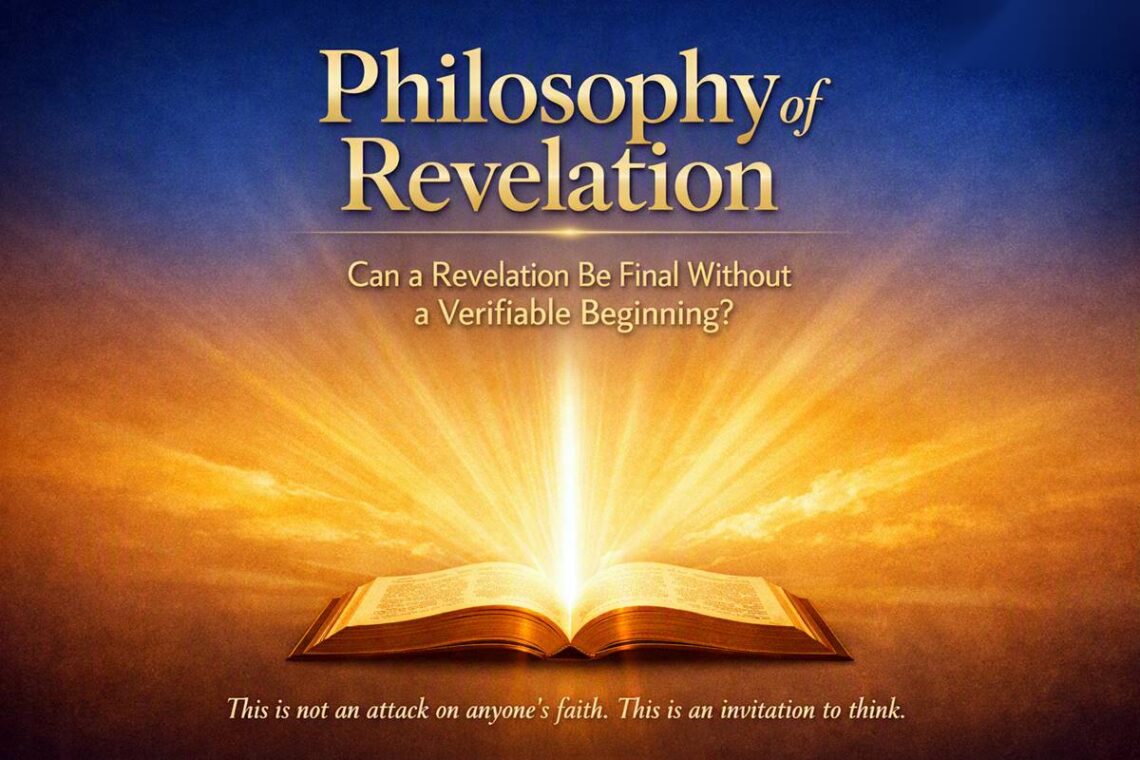
Can a Revelation Be Final Without a Verifiable Beginning?
Disclaimer: This is not an attack on anyone’s faith. This is an invitation to think.
Have you ever had someone tell you something is “final” without being able to show you what came before?
“Trust me, this is the last chapter.”
Okay… what book? Where are the previous chapters?
“Trust me, this is the final stage.”
Fine… what were the earlier stages?
Now apply that same logic to religion.
When someone says “This is the final revelation from God,” shouldn’t we be able to ask:
What came before? How do we know? And how do we verify the connection?
The Problem in a Nutshell
Here’s the paradox:
A final revelation claims to complete what came before. But if we can’t independently establish what came before… how can we know it actually completes anything?
We’re left with a declaration, not a demonstration.
And that’s where things get interesting.
What Got Me Thinking About This
The Qur’an itself raises the stakes here. It doesn’t just show up and say “I’m revelation.” It makes a relationship claim:
“And We have revealed to you, [O Muhammad], the Book in truth, confirming that which preceded it of the Scripture and as a criterion over it.”
— Qur’an 5:48
So now we have a claim about continuity. The Qur’an says it confirms earlier scriptures.
Which immediately raises the question:
What exactly is being confirmed?
The Manuscript Evidence (Because We Have To Go There)
Look, I’m not here to say manuscripts prove divine inspiration. That’s not how any of this works.
But manuscripts do give us historical access. And history matters when someone claims to be the end of a historical chain.
The Dead Sea Scrolls (The Bible’s Ancient Witness)
The Great Isaiah Scroll dates to about 125 BCE — roughly a thousand years older than the medieval manuscripts scholars previously relied on.
Does it match perfectly? No. There are variants, spelling differences, scribal errors.
Does that mean “the Bible was corrupted”? That’s not what the evidence shows either. The text generally agrees with the later tradition.
Reasonable conclusion: There’s textual variation, but also substantial continuity.
The New Testament Early Witnesses
Codex Sinaiticus (4th century) gives us the earliest complete New Testament. Earlier papyri exist for almost every book.
This doesn’t prove Christianity. But it does prove something important:
The earlier Christian textual tradition is historically accessible.
And that matters when a later document claims to correct what Christians originally believed.
The Qur’an’s Own Manuscript Witness
The Birmingham Qur’an manuscript was radiocarbon dated to 568–645 CE — remarkably close to Muhammad’s lifetime.
This is significant evidence for early Qur’anic transmission.
But here’s the crucial distinction:
Ancient manuscript = evidence of antiquity, not proof of divinity or finality.
The Jesus Problem That Nobody Can Ignore
Let’s be direct about this.
The New Testament says Jesus was crucified.
The Qur’an (4:157) says: “They did not kill him, nor did they crucify him…”
Both cannot be historically correct.
So what’s the explanation?
Option 1: The Christian texts are right → The Qur’an contradicts history.
Option 2: The Christian texts were corrupted → We need evidence of when, where, how, and what the original was.
Option 3: The Qur’an corrects a misunderstanding → What establishes the Qur’an as the correcting authority?
Option 4: The Qur’an represents a separate account → Then “confirmation” isn’t really the right word.
Notice that Option 2 often becomes circular:
- Why is the Bible wrong?Because it was corrupted.
- How do you know?Because the Qur’an says so.
- Why trust the Qur’an?Because it restores the original.
- How do we know it restores the original?Because the Bible is wrong…
That’s a closed loop. And the question becomes:
What independent evidence breaks the circle?
The “Corruption” Argument Gets Complicated
Here’s something that surprised me when I dug deeper:
The Qur’an doesn’t simply say “the entire Bible is corrupted.” It’s more nuanced.
It speaks positively of the Torah and Gospel. It criticizes some people for distorting words, concealing revelation, or misrepresenting scripture.
So a serious question becomes:
Does the Qur’an claim textual corruption of the scriptures themselves, interpretive corruption by communities, selective concealment, or some combination?
That’s a much better question than repeating slogans. And whatever answer is given, it should be tested against the Qur’anic text itself.
The Structure Problem
Here’s the philosophical challenge:
The final revelation becomes the primary authority for reconstructing the earlier revelation.
Sequence becomes:
- Earlier revelation exists
- Earlier revelation allegedly becomes lost/corrupted
- Final revelation appears
- Final revelation tells us what the original actuallymeant
Question: How can we independently distinguish genuine restoration from reinterpretation?
If we can’t, the system becomes difficult to falsify.
What Counts as Evidence?
I proposed a test. Fair for any tradition.
A claim of final revelation should be examined under seven headings:
- Historical Origin— Where and when?
- Textual Preservation— What’s the earliest evidence?
- Earlier Revelation— What exactly came before?
- Continuity— How does it connect?
- Agreement— Where does it genuinely confirm?
- Contradiction— Where does it differ, and why?
- Final Authority— What independently establishes it’s God’s final word?
Apply this to any tradition. Christianity, Islam, Judaism — the framework works.
The Central Paradox
A final revelation claims: “I complete what came before.”
But if what came before cannot be independently established, then we cannot independently establish that the later revelation actually completes it.
We can only accept the claim.
So finality becomes a matter of declaration rather than demonstration.
This doesn’t prove the revelation is false.
It establishes something more precise:
The claim of finality has not been demonstrated merely by asserting finality.
That distinction matters. A lot.
Let’s Be Honest: This Applies to Christianity Too
I’m not playing favourites here.
If Christianity says “Jesus is the definitive revelation of God” — Why?
If Christianity says “The New Testament faithfully preserves the apostolic witness” — What evidence?
If Christianity says “Jesus fulfilled the Old Testament” — What does fulfilment mean, and can it be demonstrated?
The standard must be consistent. Otherwise, this isn’t inquiry — it’s just apologetics.
The Real Burden of Proof
The person claiming “This is the final revelation from God” is making an extraordinary claim.
The question isn’t: “Can you prove with mathematical certainty it’s false?”
The reasonable question is: What positive evidence establishes its finality?
That evidence should ideally be:
- Historical
- Textual
- Coherent
- Non-circular
- Independently examinable
- Capable of answering serious objections
Questions That Deserve Answers
I’ll end with the questions that kept me thinking:
- If the Qur’an confirms the Torah and Gospel, what specific textsdoes it confirm?
- If the original Torah and Gospel were altered, when did the alteration occur?
- What historical evidence identifies the original reading?
- Why should the Qur’an’s reconstruction of earlier scriptures be accepted independentlyof its own authority?
- How should Qur’an 5:44 and 5:46 (which speak positively of the Torah and Gospel) be reconciledwith claims they were fundamentally corrupted?
- If Qur’an 5:48 says it confirms previous scripture, what does “confirm” mean when substantial historical disagreementsexist?
- How should Qur’an 4:157 be reconciled historically with the earlier Christian textual tradition concerning Jesus’ crucifixion?
- What evidence establishes that Muhammad’s status as the final prophet is truerather than merely asserted?
- If finality is based primarily upon the final revelation’s own claim, how is that claim independently verified?
- What would actually falsify the claim of final revelation?
That last one might be the most important.
If the answer is “Nothing could falsify it”… we need to ask whether we’re dealing with an evidence-based historical conclusion or an unfalsifiable theological commitment.
The Invitation
This isn’t asking anyone to abandon faith.
It’s asking everyone to examine the foundations of faith.
- Don’t defend your position merely because it’s yours.
- Don’t reject another position merely because it’s different.
- Don’t confuse confidence with evidence.
- Don’t confuse criticism with hatred.
- And don’t be afraid of questions.
Because if something is true, honest investigation should ultimately strengthen it.
What Do YOU Think?
Let’s actually discuss this.
- If you believe the Qur’an is the final revelation, what evidence demonstrates the claim?
- If you’re Christian, how do you answer the same questions about your tradition?
- If you’re neither, what standard of evidence seems reasonable?
Drop your thoughts in the comments. I’ll actually read them.
And if you find this worth sharing, send it to someone who needs