Philosophy Of Revelation Part 2

THE FINALITY PARADOX
The Qur’an, the Bible and the Test of Continuity
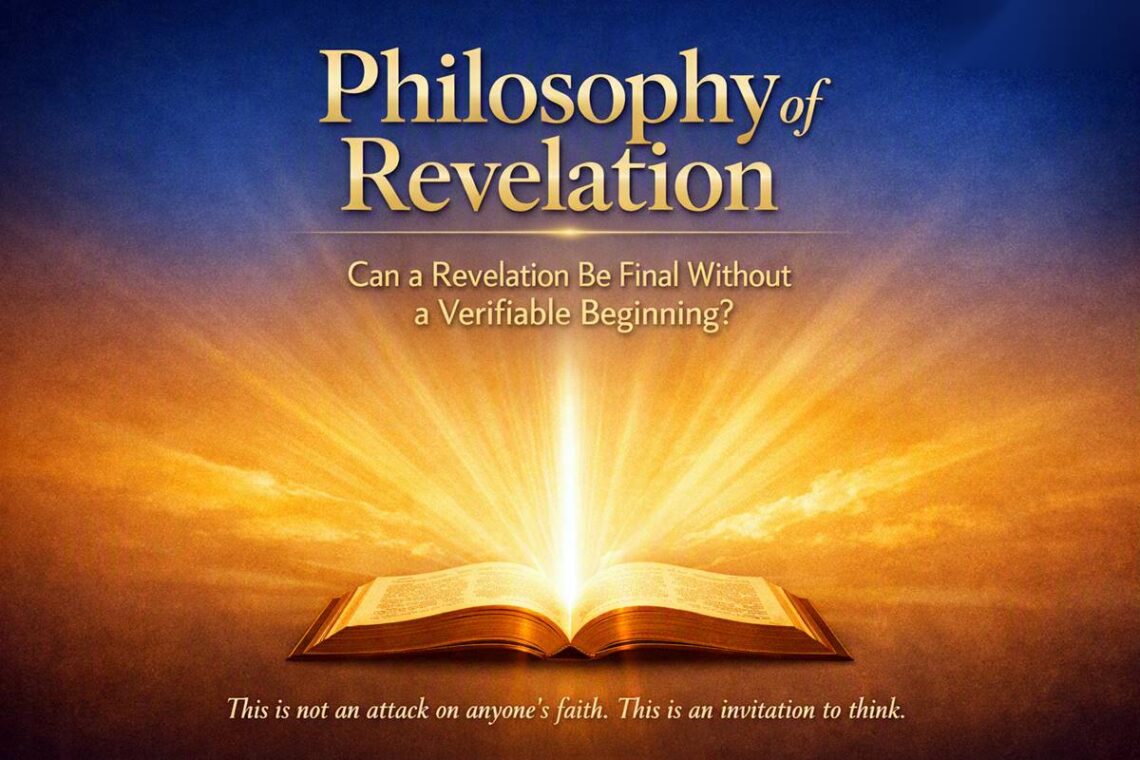
Can a revelation be called “final” if the chain it claims to complete is disputed?
This is not an article written to insult Muslims. It is not written to attack Christians. It is not an attempt to settle a theological debate with emotion. It is a question of reason, history, textual evidence and epistemology. And perhaps the most important question is this: if the Qur’an is the final revelation in a continuing chain of divine revelation, can that finality be demonstrated through the chain itself?
The question becomes especially important because the Qur’an does not present itself as an isolated book appearing without historical context. It repeatedly refers to earlier revelation. And that gives us something extremely important: a testable continuity claim.
Let the Qur’an Make Its Own Claim
The Qur’an speaks positively about the Torah. Qur’an 5:44 says that Allah sent down the Torah and describes it as containing “guidance and light”. It also says that prophets, rabbis and scholars were judged by it.
Then Qur’an 5:46 speaks of Jesus, saying that he was “confirming that which came before him in the Torah”, and describes the Gospel as containing “guidance and light” and confirming what preceded it in the Torah.
Then comes Qur’an 5:48. The Qur’an describes itself as a revelation “confirming that which preceded it of the Scripture” and as a criterion or authority over it.
This is significant. The Qur’an is therefore not merely saying, “Here is another religious book.” It places itself within a history of revelation. There is a sequence: Torah → Gospel → Qur’an. And Muhammad is presented as the seal of the prophets: “the Messenger of Allah and the seal of the prophets” — Qur’an 33:40.
So the claim is stronger than chronology. It is a claim of continuity, confirmation and completion. And that is where the difficult questions begin.
What Exactly Does “Confirming” Mean?
This may be one of the most important questions in the entire discussion. If a later revelation says that it confirms an earlier revelation, what does confirmation mean?
Does it mean that it agrees substantially with the earlier revelation? Does it confirm its central message? Does it confirm only the original revelation before textual alteration? Does it confirm some portions but correct others? Does it restore the original message after corruption? Or does it simply affirm that God originally revealed those books?
These possibilities are not identical. And the distinction matters enormously.
Because if the Qur’an confirms an earlier revelation, we need to ask: Which earlier revelation? Where is it? What did it say? Can we identify it historically? Can we compare it with the text that existed before Muhammad? And if the earlier revelation had already been corrupted, when did that corruption occur?
Was it before Jesus? After Jesus? Before Muhammad? After Muhammad? Who changed it? What was the original wording? Where is the evidence for the original version?
These are not hostile questions. They are precisely the questions required when one makes a claim of historical continuity.
The Qur’an Does Not Simply Say “The Previous Books Were Useless”
This point deserves intellectual honesty. A simplistic argument sometimes says, “The Qur’an says the Bible was corrupted.” That is too crude.
The Qur’an contains passages that criticise some People of the Book for concealing, distorting or misusing words and scripture. Qur’an 4:46, for example, speaks of people altering words from their proper places.
But Qur’an 5:44–48 is more complicated than simply saying, “The Torah and Gospel are completely false.” Instead, the Qur’an describes the Torah as revelation containing guidance and light, describes the Gospel similarly, tells the People of the Gospel to judge by what Allah revealed therein, and then describes the Qur’an as confirming what preceded it.
Therefore, the intellectually serious question is not, “Does Islam believe in the Bible?” That is too simplistic.
The better question is: What relationship does the Qur’an claim to have with the Torah and Gospel, and can that claimed relationship be demonstrated historically?
That is a much harder question.
Now Bring the Bible into the Discussion
The Bible makes its own continuity claim. The Hebrew Scriptures do not simply appear as disconnected religious writings. They develop a narrative: creation, humanity’s fall, Abraham, Israel, Moses, the covenant, the prophets, the Davidic promise and messianic expectation.
Then the New Testament claims that Jesus stands within that story.
For example, Deuteronomy 18:18 speaks of a future prophet like Moses to whom God would give His words. Jeremiah 23:5 speaks of a coming righteous Branch from David. Isaiah 53 presents a suffering figure who bears grief and suffering and is associated with the sins of others.
Then the New Testament makes a very explicit claim. After Jesus’ death and resurrection, Luke 24:27 describes Jesus explaining from Moses and the Prophets what the Scriptures said concerning Him. Luke 24:44 records Jesus saying that what was written about Him in the Law of Moses, the Prophets and the Psalms had to be fulfilled.
That means Christianity’s claim is fundamentally one of continuity.
Christianity does not say, “Forget everything that came before.” It says, in effect, “Look backwards. The earlier writings form the framework in which the identity and mission of Jesus must be understood.”
That is a claim that can be investigated.
The Two Claims Side by Side
Here is where the discussion becomes interesting.
The biblical claim is that the earlier Scriptures anticipate and provide the framework for the Messiah, and that Jesus fulfils that story.
The Qur’anic claim is that the Torah and Gospel are revelations from God, that Jesus confirms what preceded Him, and that the Qur’an comes confirming what preceded it while functioning as a criterion over it.
Now ask: What does the historical record allow us to establish about those earlier Scriptures?
This is where we move from theology to history.
The Great Isaiah Scroll Changes the Discussion
Consider the Great Isaiah Scroll. It was discovered among the Dead Sea Scrolls at Qumran. The Israel Museum dates it to approximately 125 BCE. It contains all 66 chapters of Isaiah and is generally in agreement with the later Masoretic textual tradition, while also containing variant readings, spelling differences, scribal errors and corrections.
Think carefully about what that means.
The question is not, “Does every letter match a medieval manuscript?” It does not.
The question is: Do we possess evidence of biblical textual traditions centuries before Jesus and more than half a millennium before Muhammad?
Yes.
And that is historically significant.
It means that claims about the Hebrew Scriptures cannot simply be evaluated by looking at medieval manuscripts. We can go much further back. We have physical evidence. We can compare textual traditions. We can identify both stability and variation.
That is exactly what historical investigation is supposed to do.
The New Testament Also Has an Early Manuscript Tradition
The same principle applies to the New Testament.
Codex Sinaiticus, generally dated to the fourth century, contains the earliest complete surviving copy of the Christian New Testament. The manuscript has also been heavily corrected by different hands.
And that fact should not be hidden.
There are corrections. There are textual variants. There are differences between manuscripts. Christian textual scholarship openly studies these differences.
That is important because textual criticism exists precisely. After all, manuscript transmission involves variation.
But here is the crucial distinction: textual variation does not automatically equal total textual corruption.
The existence of corrections and variants tells us that manuscripts were copied by human beings. The historical question then becomes: Can the earlier text be reconstructed with sufficient confidence from the surviving evidence?
That is a much more sophisticated question than, “Are there differences between manuscripts?”
Of course there are.
The real question is what those differences actually do to the substance of the text.
Now Consider the Qur’anic Manuscript Evidence
The Qur’an also has an important early manuscript tradition.
The Birmingham Qur’an manuscript contains portions of Surahs 18–20. Radiocarbon testing of its parchment produced a date range of 568–645 CE with 95.4% probability. The University of Birmingham describes it as one of the earliest surviving Qur’anic fragments.
Again, intellectual honesty requires an important qualification: radiocarbon dating dates the parchment, not necessarily the exact moment the ink was written.
So we should not turn a scientific dating result into a claim it cannot prove.
Nevertheless, it provides important evidence for the existence of Qur’anic textual material very early in Islamic history.
And this is exactly the kind of evidence that should be examined.
Not feared.
Examined.
Now Comes the Real Test
We now have something fascinating.
We have earlier biblical manuscripts, later biblical manuscripts, early Qur’anic manuscripts and later Qur’anic manuscripts. We have textual traditions. We have historical claims. We have theological claims. We have competing interpretations.
So the discussion should no longer be, “My book says it is true.”
Because every sacred tradition can make that statement.
The deeper question is: What external evidence supports the internal claim?
The Jesus Question Becomes Unavoidable
This is perhaps the sharpest point of comparison.
The New Testament places the death and resurrection of Jesus at the centre of its message. Paul’s argument in 1 Corinthians 15 makes the resurrection foundational to Christian proclamation.
The Qur’an, however, explicitly denies that Jesus was killed or crucified in Qur’an 4:157, saying that it was made to appear so.
That is not a minor difference.
It is a major historical and theological contradiction.
And now the question becomes extraordinarily important: What historical evidence should we use to decide between these competing claims?
The answer cannot simply be, “The Qur’an says this.” Because that would be circular if the question is whether the Qur’an’s historical claim is true.
Likewise, a Christian cannot simply say, “The Bible says Jesus was crucified.” That is also insufficient if the question is whether the biblical account corresponds to history.
Both claims must face historical examination.
The Final Revelation Claim Therefore Faces a Unique Burden
If Muhammad is the seal of the prophets, as Qur’an 33:40 states, then the Qur’an’s claim is not merely that Muhammad brought another message. It is that the prophetic sequence reaches its seal with him.
But finality raises a problem.
Suppose I arrive at the end of a chain and announce, “I am the final link.”
You can ask: Where is the chain?
I might answer, “The earlier links existed, but they were corrupted.”
You can then ask: What were the original links?
If I answer, “You cannot know because they were corrupted,” you can reasonably ask: Then how can you demonstrate that I am actually completing the original chain rather than replacing it with a new one?
This is the Finality Paradox.
The Corruption Argument Must Also Be Tested
Suppose the answer is: “The Torah and Gospel originally taught the same thing, but Christians and Jews corrupted them.”
That is possible as a hypothesis.
But a hypothesis is not automatically history.
We must ask: Where is the evidence? What did the original text say? When was it corrupted? By whom? What manuscripts preserve the pre-corruption version? Can those manuscripts be independently dated? Do they predate the alleged corruption? Do they agree with the later revelation? Can we reconstruct the original message?
And most importantly: If the earlier revelation is no longer recoverable, how can the later revelation demonstrate that it is confirming it?
This is where epistemology becomes unavoidable.
A Claim Cannot Simultaneously Destroy Its Own Standard of Verification
Consider the logic.
If the later revelation says, “The earlier revelation was from God,” that is one claim.
If it then says, “The earlier revelation has been corrupted,” that is another claim.
But if we cannot independently establish what the original earlier revelation said, then the later revelation becomes the primary source for telling us what the earlier revelation supposedly originally meant.
That creates a serious epistemological problem.
Because then we may be reasoning:
The later revelation is true because it correctly restores the earlier revelation.
We know what the earlier revelation originally taught because the later revelation tells us.
And we know the later revelation is correct because it restores the earlier revelation.
That risks becoming circular.
The question therefore becomes: What independent evidence breaks the circle?
But the Christian Position Must Face the Same Standard
This argument should not become a double standard.
Christians must also answer difficult questions.
How were biblical texts transmitted? Why are there textual variants? Why are there different manuscript traditions? Why did the canon develop historically? Why do some passages have disputed textual histories? How do we distinguish original wording from later scribal additions?
These are legitimate questions.
And Christian faith should not be afraid of them.
The existence of manuscripts, textual variants and corrections is not evidence that Christians should stop investigating. It is the reason investigation is necessary.
The Real Question Is Not “Which Book Has No Variants?”
That standard would be intellectually unrealistic.
Ancient texts were copied by hand. Human beings made mistakes. Scribes corrected texts. Manuscripts developed variant readings.
The serious question is: Can we trace the textual tradition sufficiently far back to evaluate the central claims being made?
And another question: Does the later revelation actually continue the message found in the earlier revelation, or does it reinterpret and contradict it at crucial points?
This is where the argument becomes much more interesting.
“Confirmation” Cannot Mean “Contradiction” Without Explanation
Suppose an earlier document says A happened.
A later document says A did not happen.
The later document cannot simply be called a confirmation of the earlier one without explaining the contradiction.
It might argue, “The earlier document has been corrupted.”
Fine.
Then the burden becomes: Prove the corruption.
It might argue, “The original meaning was different.”
Fine.
Then: Show us the original meaning.
It might argue, “God revealed the correct version later.”
That may be a theological possibility.
But then we must distinguish historical continuity from theological supersession.
Those are not the same thing.
This Is Why Jesus Becomes the Central Test
The disagreement concerning Jesus is not peripheral. It sits directly at the intersection of the two traditions.
The Qur’an honours Jesus as a messenger of Allah and affirms the Gospel. The Bible presents Jesus as the Messiah whose suffering, death and resurrection fulfil the earlier Scriptures.
The Qur’an rejects the crucifixion claim in 4:157. The New Testament makes Jesus’ death and resurrection central.
So here is the question:
If the Qur’an is confirming the earlier revelation, what exactly is it confirming about Jesus?
And if its account of Jesus contradicts the historical testimony of the earlier Christian sources, how should that contradiction be explained?
This is not a question that should be answered with anger.
It should be answered with evidence.
Now Ask the Most Uncomfortable Question
What if the problem is not, “Which religion has the better argument?”
What if the deeper problem is: What standard are we using to decide what counts as revelation in the first place?
If the standard is, “My book says it came from God,” then every book can make the same claim.
If the standard is, “My religious community says it is true,” then every community can make the same claim.
If the standard is, “It is later, therefore it is final,” then chronology becomes confused with authority.
So we need something stronger.
A Serious Test for a Claim of Final Revelation
A genuine claim of final revelation should be able to answer at least these questions.
Origin: Where does the revelation claim to come from?
Beginning: What earlier revelation is it completing?
Continuity: Can the connection between the earlier and later revelation be historically demonstrated?
Preservation: What evidence exists for the earlier revelation before the later revelation appeared?
Confirmation: Does the later revelation actually confirm the earlier revelation?
Contradiction: Where does it disagree with earlier revelation, and why?
Corruption: If contradiction is explained by corruption, where is the independent evidence for that corruption?
Historical Testability: Are the claims capable of being examined against historical evidence?
Non-Circularity: Can the truth of the final revelation be demonstrated without simply assuming that revelation is true?
Finality: What establishes that the sequence actually ends here?
That is a demanding test.
But a claim of ultimate truth deserves a demanding test.
And Here Is the Question I Want to Leave With You
If the Qur’an is the final revelation, where does the sequence begin?
If it confirms the Torah, which Torah does it confirm?
If it confirms the Gospel, which Gospel does it confirm?
If the earlier texts were corrupted, when were they corrupted? Who corrupted them? What did the originals say? Where are the pre-corruption manuscripts?
If Jesus was not crucified, what historical evidence establishes that claim?
If Jesus was crucified, how should Qur’an 4:157 be understood?
If Jesus fulfilled the earlier Scriptures, which interpretation of those Scriptures best explains the historical development of the Christian claim?
And if Muhammad is the seal of the prophets, what independently establishes that this prophetic sequence actually ends with him?
This Is Not an Invitation to Insult — It Is an Invitation to Think
Muslims should be free to challenge Christianity. Christians should be free to challenge Islam. Neither side should be afraid of questions.
If a claim is true, examination should strengthen it.
If an argument is weak, examination should expose it.
And if we genuinely care about truth, we should be willing to discover that some of our assumptions may need to change.
So do not just ask, “What does my religion teach?”
Ask: Why should I believe it?
Do not just ask, “What does my book claim?”
Ask: What evidence supports the claim?
Do not just ask, “Is this revelation final?”
Ask: What makes it final?
THE CHALLENGE
If you believe the Qur’an is the final revelation, do not merely tell us that it is final.
Show us the beginning. Show us the chain. Show us the continuity. Show us the preservation. Show us the confirmation. Show us the historical evidence. Show us the reason for the contradictions. And most importantly, show us why the claim is not circular.
If you believe Christianity is true, subject Christianity to exactly the same standard.
If you believe both are wrong, bring your evidence.
If you think this argument has missed something important, show us where.
If you disagree, explain why.
If you have evidence that challenges this argument, bring it.
And if this article has raised a question you have never seriously considered before, ask the question.
What do you think?
Can something genuinely be called the “final revelation” if the continuity of the revelation it claims to complete cannot be independently demonstrated?
Comment. Question. Challenge. Correct. Discuss.
And if you think this is a question worth examining, share the article.
Because the goal is not to win an argument.
The goal is to find out what is true.