
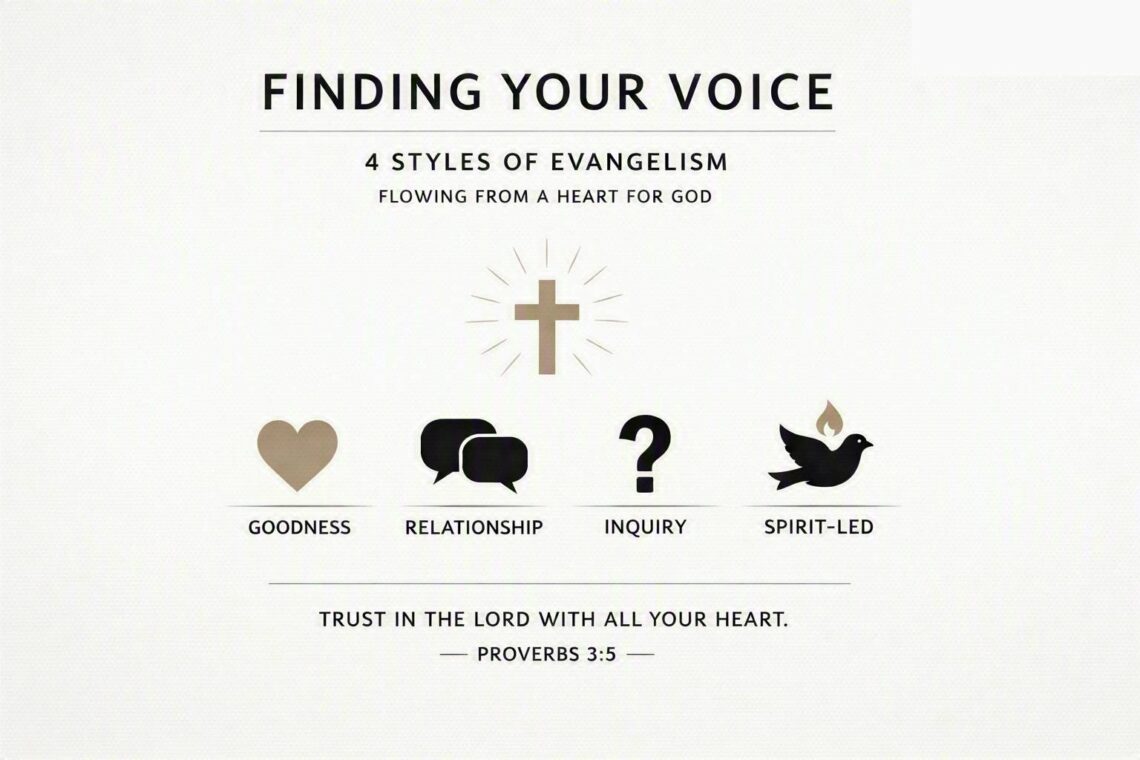
Finding Your Voice in Evangelism

4 Styles of Evangelism That Flow from a Heart for God
Opening Reflection
One of the hardest things for anyone to do is to start. Beginning something new requires courage, faith, and a willingness to move beyond our comfort zones.
But perhaps one of the greatest challenges for Christians is something deeper: trying to live the Christian life using only our own mind, heart, and strength instead of depending on God.
Scripture reminds us of the true foundation of the Christian life:
“Trust in the Lord with all your heart and lean not on your own understanding.” — Proverbs 3:5
The Christian life was never meant to be lived by human effort alone. Evangelism, especially, is not something we accomplish through intelligence, personality, or persuasion. It flows from dependence on God.
Evangelism is not a formula.
It is an overflow.
It is not a performance.
It is relationship expressed outwardly.
When someone genuinely experiences God, sharing Him becomes natural.
1. Evangelism Through the Goodness of God
Evangelism begins with a simple but powerful conviction: God is good.
If Christ is not good to you personally, it will be difficult to convincingly present Him as Good News to someone else. The Gospel is called Good News because it reveals the goodness, mercy, and love of God toward humanity.
“Oh, taste and see that the Lord is good.” — Psalm 34:8
Before speaking to others, ask yourself:
- Is Christ good for me?
- Have I experienced His goodness?
- Do I truly believe God is good even in difficulty?
If you do not see or experience the goodness of God, your message becomes theory instead of testimony. Good news comes from experience. You cannot advertise what you have never tasted.
This style of evangelism focuses on:
- Sharing testimonies
- Demonstrating gratitude
- Reflecting joy
- Showing hope during trials
When people see peace in your storm, they begin to ask questions. That moment becomes the doorway to evangelism. The issues we go through before ministry are often a sign of something deeper at work.
2. Relationship Analogy Evangelism
This style uses human relationships to explain spiritual truth.
Ask simple but powerful questions:
- Can you relate deeply with someone you never talk to?
- Can I say, “That is my wife,” yet I have never spoken to her?
- If we never spend time together, can we call it a relationship?
No communication means no relationship.
Union means:
- Being together physically and spiritually
- Agreement
- Mutual understanding
- Access to clarification
- Love expressed and received
Now apply that to God.
Many people today:
- Have heard about God but do not live by His principles
- Are searching for God
- Follow God only when their expectations are met
- Seek Him only in pain and suffering
- Desire a relationship with God on their own terms
- Want blessings without surrender
- Love the idea of God but resist obedience
- Confuse religion with intimacy
This analogy helps people understand that Christianity is not about attendance — it is about intimacy.
“Draw near to God and He will draw near to you.” — James 4:8
A Common Human Struggle
There is something deeper happening in the human heart. Often, people want God, but they want God on their terms. There is always a subtle desire within us to be in control — even with God.
We may say we trust Him, but sometimes our hearts say:
- I want God to do things my way.
- I want prayers answered my way.
- I want God to respond according to my expectations.
But this raises an important question:
If God always does things your way, is He still God — or have you become the god?
Who is the Master?
Part of true relationship with God is learning to trust His wisdom above our own. God’s wisdom is infinite. Our understanding is limited.
“For my thoughts are not your thoughts, neither are your ways my ways, declares the Lord.” — Isaiah 55:8
To truly experience God’s wisdom, we must sometimes release control. Allow God. Let go. And let God.
Who This Style Helps
Evangelism through relationship helps reach:
- The disappointed believer
- The religious but distant person
- The truth seeker
- The wounded and confused
- Those trying to redefine God according to culture
It shifts the conversation from:
“Do you go to church?”
to
“Do you actually know Him?”
3. Inquiring Evangelism
This style is conversational and investigative. Instead of assuming what someone believes, begin by asking questions.
Start with:
- What have you heard about Jesus?
- What is your understanding of God?
Inquiring removes assumptions. It:
- Saves time
- Reveals the real issue
- Avoids unnecessary preaching
- Creates meaningful engagement
However, it may bring arguments. Be aware:
Some people ask questions to understand. Others ask questions to debate. Discern the difference.
“Be wise as serpents and harmless as doves.” — Matthew 10:16
Inquiring evangelism requires:
- Listening more than speaking
- Emotional intelligence
- Patience
- Discernment
Often the question behind the question is pain.
4. Spirit-Led Evangelism
This is the foundation of all true evangelism. Evangelism must be Spirit-led, not ego-led.
- John 16:8 — The Spirit convicts
- Acts 1:8 — You shall receive power
- Luke 12:12 — The Spirit will teach you what to say
- Romans 8:14 — Those led by the Spirit are sons of God
If you are sensitive to the Spirit, He will guide you. What you speak. The answers you give. Even the moments you choose to remain silent. All must be Spirit-directed.
The Holy Spirit:
- Brings conviction
- Gives wisdom
- Reveals hidden pain
- Knows the real issue
- Provides the right words
Evangelism is allowing the Spirit to remind you what to say and when to say it. Never let knowledge replace dependence on the Holy Spirit. And never be afraid to say:
“I do not know.”
Humility invites grace.
Guardrails for Every Style
Never be afraid to say:
“I do not know.”
You are not the Holy Spirit. Never let knowledge replace dependence on the Spirit. The Spirit convicts. The Spirit persuades. The Spirit transforms. We simply cooperate.
What Evangelism Is NOT
Evangelism is not:
- Filling a church building
- Competing for numbers
- Proving how much you know
- Winning arguments
- Forcing decisions
Evangelism is obedience and love. Results belong to God.
Closing Truth
Every believer has a style. Some are relational. Some are bold. Some are analytical. Some are compassionate.
But every style must be:
- Rooted in God’s goodness
- Anchored in relationship
- Led by the Spirit
Which style resonates most with you? Share your thoughts in the comments below, and don’t forget to subscribe for more encouragement on your faith journey.